
Building Pathology: Japanese Knotweed
Originally published 2 November 2018, updated Nov 2026
In this blog I will be giving a background into Japanese knotweed, I will explain why it’s important to manage and discuss the type of treatments that are available and effective. I will also go into the legal ramifications of the failure to manage this plant as Network Rail found out to their detriment.
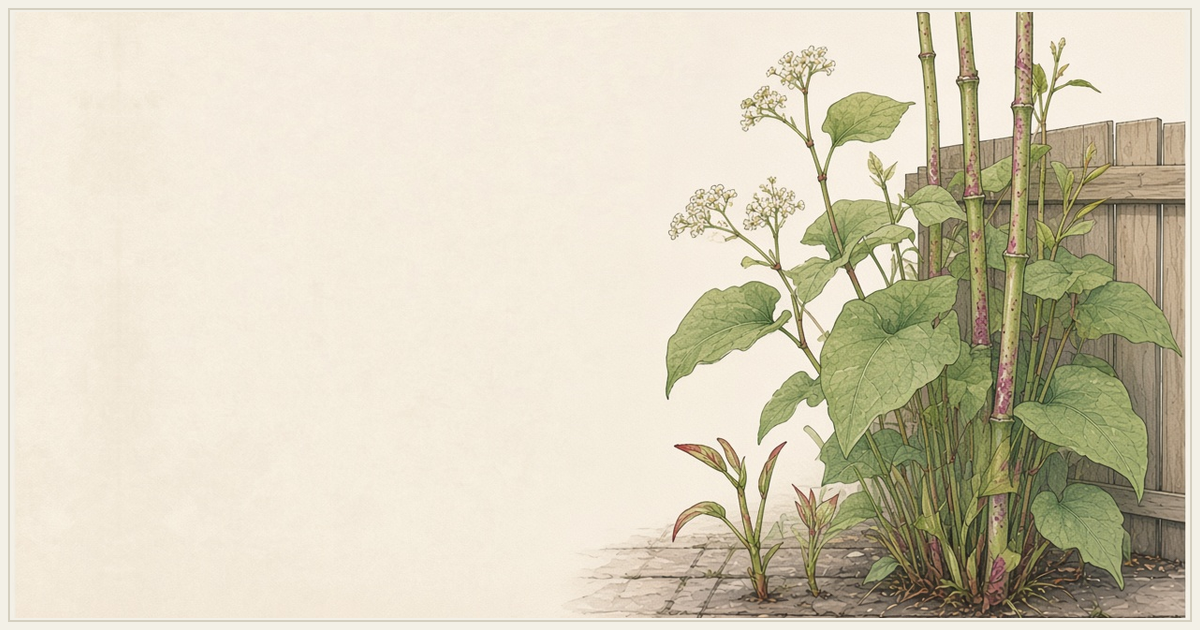
Japanese knotweed (Reynoutria japonica, still often listed under its older name Fallopia japonica) is a particularly invasive, fast growing, bamboo-like perennial plant. It spreads through its creeping root system (fibrous rhizome) which allows for its rapid spread that can grow up to three metres in height. Even a tiny amount of rhizome, as small as 10mm, can generate a new infestation reaching a depth of 3 metres and extending out up to 7 metres from the parent plant stem.
Now, this seems to be the absolute worst case scenario in terms of growth. 2018 research conducted by AECOM and the University of Leeds suggests that Japanese knotweed rhizomes rarely extended more than 4m from above-ground plants and that rhizome spread was generally less than 2.5m. That research has since fed directly into the RICS guidance, which now uses 3m rather than 7m as its benchmark distance (more on that below).
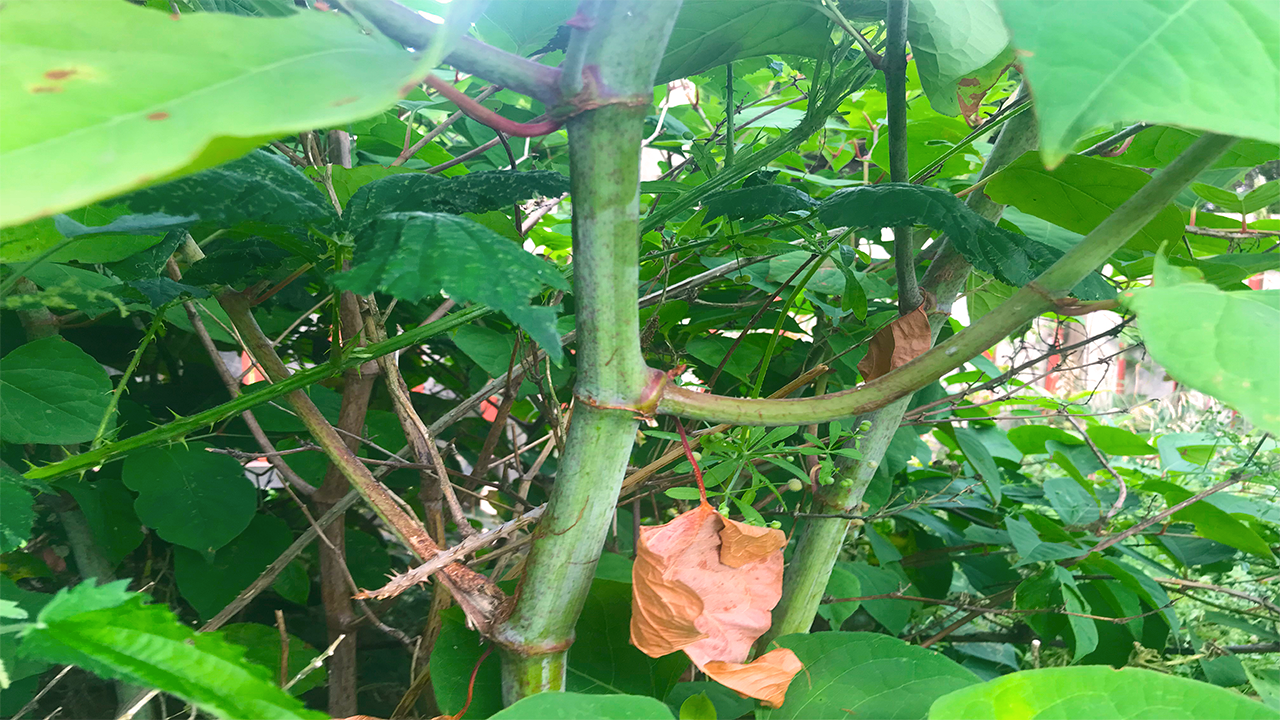
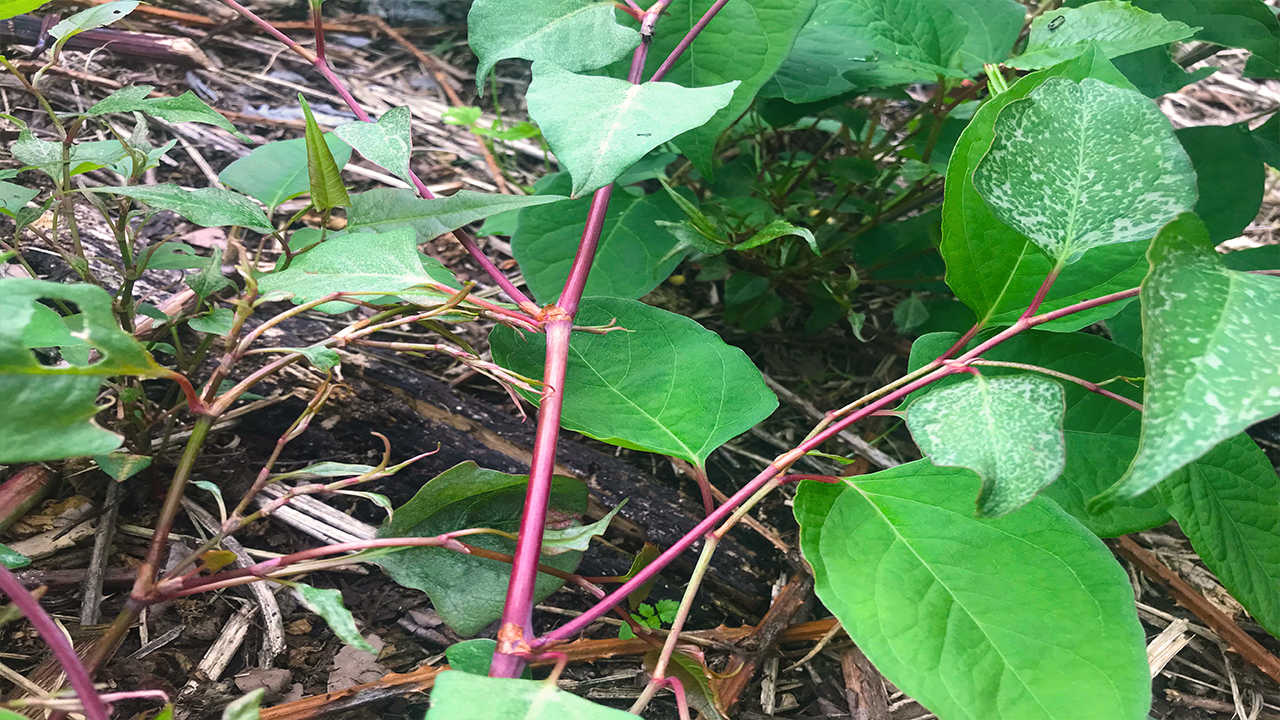
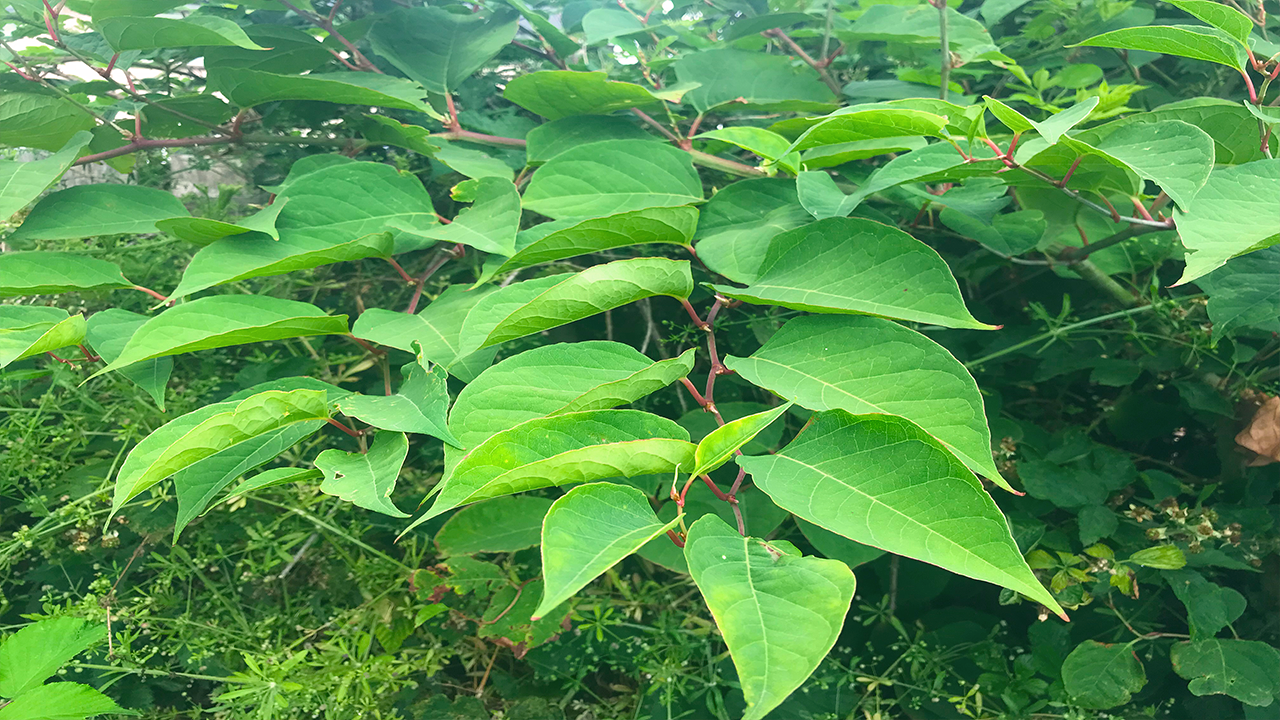
When I first wrote this blog the RICS had a 2012 Japanese knotweed information paper which contained a handy identification chart. That paper has now been replaced by the RICS professional standard Japanese knotweed and residential property (first published January 2022, effective from March 2022 and reissued as a professional standard in October 2022). The new standard points surveyors towards the Property Care Association’s guidance for valuers and surveyors for identification, and expects us to know what the plant looks like in every season. The plant starts out with a red-tinged shoot with spade-shaped green leaves zig-zagged from the stem. These will mature to become more prominent chunky green stems with distinctive purple speckles. Spikes of small white flowers can be seen around October and in the winter the plant dies back leaving distinctive brown hollow dead canes.
What the 2022 RICS standard changed
The old 2012 approach looked at whether knotweed was within 7 metres of the property. The 2022 standard replaces this with four management categories:
- Category A: Action – knotweed on the property causing visible material damage to a significant structure.
- Category B: Action – no structural damage, but the knotweed is likely to prevent use of, or restrict access to, amenity space.
- Category C: Manage – knotweed on the property but not causing damage or affecting amenity.
- Category D: Report – knotweed on neighbouring land within 3 metres of the boundary.
For lenders, the standard anticipates that with Category A or B most will require, as a condition of the mortgage and subject to a retention, an inspection by a remediation specialist who is a member of a recognised trade body (such as the Property Care Association), and completion of the recommended works under a Japanese Knotweed Management Plan backed by an insurance-backed guarantee. For Category C and D retentions are not normally expected. Knotweed seen more than 3m beyond the boundary does not normally need to be reported to a lender at all, although a note should be made. In short, the lending picture is a lot more proportionate than it was in 2018, which is good news for tenants and owners trying to buy or remortgage.
Background
Over one hundred years ago the Royal Horticultural Society and the influential horticulturalist, Gertrude Jekyll, were warning against planting Japanese knotweed. The resilient plant was introduced to Europe from Japan in the mid-19th century by renowned Bavarian plant importer Phillip von Siebold and was first recorded in the wild in the UK in Maesteg, South Wales in 1886.
The plants incredible resilience is down to its native habitat. Originating from Japan’s volcanic mountain ranges, it was able to survive in extremely harsh environments utilising its underground stems to make use of the limited nutrients available. This means the plant is able to grow in almost anywhere in the UK from sandy beaches to heavy asphalt, earning its title as one of the most problematic plant species in the UK and Ireland.
Japanese knotweed can cause various damage although its effect in some cases has been overstated. It can be particularly expensive to remedy, especially as most buildings insurance policies do not cover the resultant damage caused by the plant. It can disrupt drains, damage fencing, grow between slabs and undermine garden walls with shallow foundations.
It must be stressed that although Japanese knotweed can damage built structures, it is usually because an existing weakness or defect has been exacerbated. Structural damage to residential properties is actually quite rare and there is a lack of evidence to support the claim that it causes damage in excess of the norm for many other invasive plants.
Court Case
So, what happens if you have Japanese knotweed within your organisations land and you do not heed requests to tackle this invasive plant. Well, in a 2018 landmark case (Network Rail Infrastructure Ltd v Williams and Waistell [2018] EWCA Civ 1514) we found out. In this case two neighbouring homeowners were each awarded roughly £15k in compensation based on the fact that Network Rail had ignored requests to intervene when the plant was growing on to their land.
The Court of Appeal judgment was published on the 3rd of July 2018. The Court of Appeal unanimously upheld the initial decision, but on the basis that the encroachment of the Japanese knotweed rhizomes had diminished the claimants’ ability to enjoy the amenity and utility of their respective properties, rather than simply because it had knocked value off them.
The principal legislation that covers the control of Japanese knotweed is the Wildlife and Countryside Act 1981. The Wildlife and Natural Environment (Scotland) Act 2011 has amended this act but from a cursory analysis there has been no major differences in regards to Japanese knotweed apart from slightly strengthening the existing legislation. It is an offence to release or plant Japanese knotweed in the wild regardless of intention, knowledge or negligence. Also soil containing Japanese knotweed is considered a controlled waste under The Environmental Protection Act 1990.
Treatment
There are a range of treatments available for Japanese knotweed including:
- On-site burial and/or encapsulation with membranes
- Excavation of the plant and its roots
- Biological control
- Chemical control
The Property Care Association’s Code of Practice: Management of Japanese Knotweed was updated in November 2023 and is a good place to start for what best practice looks like, from site inspections to management plans.
The treatment I will be discussing in a bit more detail is a chemical control treatment and monitoring programme we used for a property of ours. Chemical control is the application of specialised herbicides to Japanese Knotweed plants over a period of several growing seasons. A study from Swansea University explained that while no treatment completely eradicated R. japonica, a multiple-stage glyphosate-based treatment approach provided greatest control.
The property in our case was treated with a 3-4 year spraying and monitoring programme, the treatment in our case was a glyphosate based herbicide. Glyphosate is a systemic herbicide which acts by blocking a plant’s enzyme system. The herbicide is absorbed through growing leaves and stems and travels throughout the plant and root network. It is a fairly standard weed killer, but professional-strength products can only be applied by someone holding the appropriate pesticide certificate, so on housing stock this is a job for a qualified contractor rather than a tub bought online. Glyphosate’s approval in Great Britain is currently under review (it runs to 15 December 2026 at the time of writing, with a further extension being considered), so check its current approval status with your contractor before specifying it.
Applications of the herbicide will take place during the growing season between May and October the first application of the season will not take place until the stems are roughly 500mm - 1 metre in height. Applications could be sprayed, injected or wiped depending on the situation and is most effective to be applied during the growing season when the plant is in leaf. Patience is the key here as increasing the herbicide dose does not improve knotweed control.
As good practice the Japanese Knotweed should be treated simultaneously. The schedule of visits suggested by the contractor we used was as follows:
Year 1 – 2x Visits
Year 2 – 2x Visits
Year 3 – 1x Visit
Year 4 – 1x Visit
Proactive professionals
A greater awareness may allow construction professionals to recognise, identify and manage Japanese knotweed effectively. This will prevent costly claims and legal fees if the plant is making its way into adjacent land. A better understanding will allow rationality to prevail as studies have shown it’s not as damaging to structures as some have claimed, and the RICS guidance has now caught up with that evidence. Effective treatments are available and can provide good control of the plant giving organisations little reason to ignore it.
Thanks for reading this blog, feel free to subscribe via email to get notified of the most up to date blog posts.
Note: This blog was used as the basis for an article written for the Building Engineer Magazine November 2018 edition p14-15.
Further reading
- RICS professional standard – Japanese knotweed and residential property (2022) 1st ed
- PCA – Code of Practice: Management of Japanese Knotweed (November 2023)
- Court Case – Network Rail Infrastructure Limited v Stephen Williams and Robin Waistell [2018] EWCA Civ 1514
- Research paper – Optimising physiochemical control of invasive Japanese knotweed (Jones et al, 2018)
- Research paper – Japanese knotweed (Fallopia japonica): an analysis of capacity to cause structural damage (compared to other plants) and typical rhizome extension (Fennell et al, 2018)